"This erosion of clarity over time is an inescapable problem of dance. A symphony exists on paper, the composer’s intentions clearly noted and open for interpretation by each new performer, and for study by scholars and students." Marina Harss, The Nation, Life After Merce, 2012
As beautiful as her description of the problems around choreographic legacy may be (in this case how the interpretation of Duets by Merce Cunningham was very different in feel when re-interpreted by American Ballet Theater) I wish to counter this statement of Marina Hass, which she keeps repeating elsewhere.
As composer Hans Zender points out in his book "Happy New Ears" (Verlag Herder im Breisgau, 1991) today's ways of reading music scores differ sometimes vastly from what the very same signs meant even 100 years ago: in a score by Ludwig van Beethoven, just barely 200 years apart, several indications have changed their meaning over the time since the 1800's. Moreover the entire practice of making music has changed: the mega-orchestras of today, say playing a euphorizing version of the 9th Symphony, didn't exist at his time, people had no iphones (not even in the 1990's when Zender wrote his book) etc. etc. etc.
I dare propose that it's the same with any language/system, words / elements on the one hand keep a sense of their becoming, on the other continue to change their meaning / context over time, even if they seem to remain the same in sound and form - and even the sounds change significantly with each epoch & period. For English, just think of such recent examples as American versus British English, itself a vast conglomerate of vocabularies from Anglo, Saxon, Latin-French and many others, or the very recent ongoing change of the uses of "gay" or "bitch". Another example would be Chinese writing and its change in the use of characters. All of these suggest a growth and death that could be compared to the becoming and decaying of plants, life-forms.
Just like in other literature that uses visual signs, or any kind of
tradition, I am increasingly realizing that despite any impression or
opinion, nothing is here to stay very long, because we change and the
context changes from generation to generation. Words & notions come
up and disappear, entire languages and styles die out and are
forgotten.
In what is considered classical ballet, itself a comparatively young tradition on a global scale, but even with more settled traditions, there is still considerable space for personal interpretation, taste, opinions, fashions / interests of the day, new rulers, etc., and inevitably different with every performer, each performance.
Even with a relatively unchanging medim such as video/film, it is by now possible to become nostalgic for an era that has video / film / sound but it is becoming ever more remote, and except as currently with black & white films of the first tries, one can easily forget that, as highly evident in propaganda films, life around those films may have been rather different, especially for those who were barred from being represented. Moreover, the technical standards keep changing, even rendering computer archives inaccessible by now.
And so any creation/record/ing we make is temporary, for the now, lives & is most meaningful NOW. ... As our societies are changing, while believing that they are having sound roots in set traditions, actually the traditions keep changing because as living beings we are changing, therefore what was then is no longer 100% valid for now, it has to be re-understood what was meant in the first place, then: what was the situation then, what was tried to be achieved etc.
As we are faced with the challenges of overcoming traditions of subjugation and careless exploitation, or else perish as a species, the very same impermanence gives not only greater responsibility and duty towards the cultural professionals of today, but also more space in what is accepted as "tried & true".
Good be with us all!
Friday, April 26, 2013

Saturday, April 6, 2013
influencing public space - a legacy from the 1970's
it seems con•sens•us is now somewhat of a common good - we've had the politial part live up during Occupy and still ongoing, the decisions about private & public space & rules and regulations for them ...
i keep finding it important to remind myself to listen openly when i am outside of my own home, let the situation and its details reach me beyond my general filter for my perception, accepting the seeming chaos, not having the entire overview, not being 100% in control of what's going on (this can be quite disconcerting yet familiar, even if on the surface it seems that we concede to a system of rules without questioning, the inner chaos remains ...)
these days I am more and more getting involved with the work & legacy of dance-legend Anna Halprin. her husband designed the Keller Fountain in the 1970s, and the aim was to enable more intrusive use by the general public / users of public space, in Portland, Oregon. today such freedom seems almost outdated, we've become so used to being ruled by cameras and police surveillance, being allowed to notice, but not to share beyond very narrow modes of being ...
in May there will be two moments on working on con•sens•us at CLOUD in Den Haag ...
tomorrow during a performance at the finissage of Halloween in the Spring by Vanita Monk in Rotterdam
we'll see :-)
i keep finding it important to remind myself to listen openly when i am outside of my own home, let the situation and its details reach me beyond my general filter for my perception, accepting the seeming chaos, not having the entire overview, not being 100% in control of what's going on (this can be quite disconcerting yet familiar, even if on the surface it seems that we concede to a system of rules without questioning, the inner chaos remains ...)
these days I am more and more getting involved with the work & legacy of dance-legend Anna Halprin. her husband designed the Keller Fountain in the 1970s, and the aim was to enable more intrusive use by the general public / users of public space, in Portland, Oregon. today such freedom seems almost outdated, we've become so used to being ruled by cameras and police surveillance, being allowed to notice, but not to share beyond very narrow modes of being ...
in May there will be two moments on working on con•sens•us at CLOUD in Den Haag ...
tomorrow during a performance at the finissage of Halloween in the Spring by Vanita Monk in Rotterdam
we'll see :-)
watching the monkey? re-thinking racist representation in intercultural relations
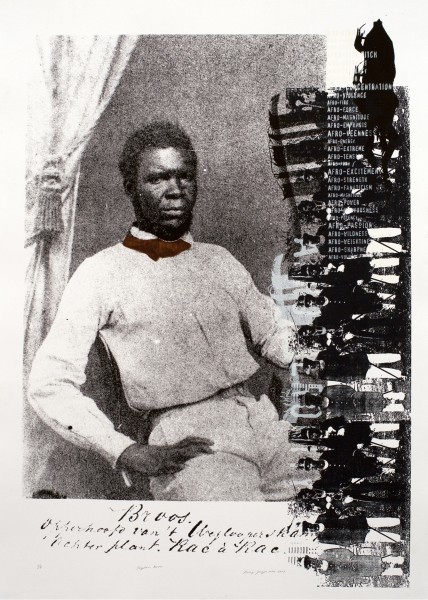 |
| print by artist Remy Jungerman |
Friday, November 2, 2012
anyone still doubt the political implications of improvising? ... read this!!
http://wagingnonviolence.org/2012/10/improvising-a-new-world/?utm_source=feedburner&utm_medium=feed&utm_campaign=Feed%3A+WagingNonviolence+%28Waging+Nonviolence%29
improvisation means ability to deal with raw real power
energy when it's at its highest
so many cultures have already been excellent at it.
so let's learn
improvisation means ability to deal with raw real power
energy when it's at its highest
so many cultures have already been excellent at it.
so let's learn
Thursday, August 2, 2012
Elaine Summers: Ouverture / By Chance - recreation as a reminder of a legacy
OUVERTURE (SPLIT SCREEN & BY CHANCE DANCE & FILM)
was originally performed in 1962 with fifteen minutes 16mm film & 1 dancer, realized for Judson Dance Theater's First Concert. Audience is requested to walk through the movie screen before seating.
In the film: Deborah Hay, Freddy Herko, Richard Brodney, Kenward Elmslie, Carol Summers, Elaine Summers, Sally Gross, Ruth Emerson, Carla Blanc, Arthur Levin, Al Carmines, George McGrath, Steve Paxton, Remy Charlip, Lila Pais, Josh Pais, John Worden, Sally Stackhouse, Harold Johnson, Joseph Schlichter, James Waring, Arlene Rothlein, Edward Barton, Rev. Howard Moody, Carolee Schneemann, Clyde, Rosie & Michael Lax, Christine Myers, Sandra Neals, Phoebe Neville, Larry Seigal, Robert Rainieri, Al Hansen, Ira Matteson, Bill Meyers, Johanna Vanderbeek, Carolyn Chrisman, Robert Ranieri, Norma Marder, Lou Rogers, John Patton, John Hoppe, Kyle Summers, Malcolm Goldstein, John Herbert McDowell, the parade for the astronauts on their return from the moon.
Don McDonagh and Robert Dunn chronicled the First Concert:
"McD: There's an interesting description by John McDowell of the opening of the first concert: 'The very first dance that ever happened at Judson was really very extraordinary in a couple of ways. First, the beginning of it, which was Bob Dunn's doing and was beautiful. The dance concert was announced to start at 8:15 and they went upstairs into the sanctuary to find that in order to get to their seats they had to walk across a movie that was going on. This movie consisted of some chance edited footage by Elaine Summers and test footage that I made... And we went on exactly, precisely for 15 minutes. The first dance which was by Ruth Emerson started on the dot of 8:30. As the movie was just about to go off, the six people or so involved came out, the movie sort of dissolved into the dance.
Dunn: Yes this was really incredible, the beginning of the first (Judson)concert. It doesn't sound like much now but it was extraordinary, my hair stands on end to think how that worked. Nobody ever did anything like that." from Don McDonagh, The Rise & Fall & Rise of Modern Dance
Congratulations to all who made it possible!
Sunday, July 15, 2012
local global universal • dreaming
as if the vast emptiness of the universe around us weren't challenge enough for our life, let alone the vast and ecological course of events on our planet where we originated and are embedded in its matrix. there will always be challenges to our existence, no need for any extra that we create ourselves. idiotic and needless to destroy our habitat and therefore ourselves before we've found out enough to be able to transplant sustainably to a new habitat. and even then, it can be fatal to no longer know of origins but internally still be bound by them, because once something it's gone, good bye ...
as if our organic life weren't already 'anarchy' enough and at the same time 'order' enough to live by and to find ways of survival. 'tribes/governments/nations/conglomerates' or 'values' may emerge over time but also dissolve like any organic entity. knowing that we're all one big super-organism, already, within all of the moons and stars. energy action voice stories language music images writing dance philosophy evolving ...
each generation anew should be presented both, the old traditional systems and at the same time the most contemporary questions and challenges. so that in the continuous interactions and exchanges optimum structures can be grown over time, for the benefit of us all. how we can live our lives in the here and now is challenge enough.
* * *
i realised once again how much dreaming be a free-flow action of our daily perception/processing/thinking/being/living when being conscious. to interfere with such a regenerative process seems to me highly risk-full because I find the value to be in the uncontrolled- / after-image / echo-like quality of dreaming .. a bit like flying actually ;-)
i believe a similar case is the practice of release-based techniques and approaches: to not 'mind-down' one's physical functioning, instead be very open and non-directive with any invasion, even just noticing one's sensations and what grows from continued noticing / perception and arrive at a responsible balance with conscious action / movement / articulation. where remains the role for conscious action, should that and only that remain the object of concentration? (a kind of black-box approach) eventually, any black box will ask for more and more refinement to ever more understand ever vaster aspects of existence.
(inspired by reading many Science Fiction books of diverse quality over many years, and the practice of body-mind work and explorations, also over many years)
* * *
once at a General Assembly @OccupyRotterdam I said to a fellow Occupier "like us bunch of dreamers" and instantly realized that I was giving us a negative and derogatory value judgement at that moment. it became clear to us both instantly and she said: "well that's the good thing about us isn't it?" - and yes it is: to dream of better possibilities and find out how it alters all the other aspects of our reality ...
as if our organic life weren't already 'anarchy' enough and at the same time 'order' enough to live by and to find ways of survival. 'tribes/governments/nations/conglomerates' or 'values' may emerge over time but also dissolve like any organic entity. knowing that we're all one big super-organism, already, within all of the moons and stars. energy action voice stories language music images writing dance philosophy evolving ...
each generation anew should be presented both, the old traditional systems and at the same time the most contemporary questions and challenges. so that in the continuous interactions and exchanges optimum structures can be grown over time, for the benefit of us all. how we can live our lives in the here and now is challenge enough.
* * *
i realised once again how much dreaming be a free-flow action of our daily perception/processing/thinking/being/living when being conscious. to interfere with such a regenerative process seems to me highly risk-full because I find the value to be in the uncontrolled- / after-image / echo-like quality of dreaming .. a bit like flying actually ;-)
i believe a similar case is the practice of release-based techniques and approaches: to not 'mind-down' one's physical functioning, instead be very open and non-directive with any invasion, even just noticing one's sensations and what grows from continued noticing / perception and arrive at a responsible balance with conscious action / movement / articulation. where remains the role for conscious action, should that and only that remain the object of concentration? (a kind of black-box approach) eventually, any black box will ask for more and more refinement to ever more understand ever vaster aspects of existence.
(inspired by reading many Science Fiction books of diverse quality over many years, and the practice of body-mind work and explorations, also over many years)
* * *
once at a General Assembly @OccupyRotterdam I said to a fellow Occupier "like us bunch of dreamers" and instantly realized that I was giving us a negative and derogatory value judgement at that moment. it became clear to us both instantly and she said: "well that's the good thing about us isn't it?" - and yes it is: to dream of better possibilities and find out how it alters all the other aspects of our reality ...
Friday, May 11, 2012
de raaf / raven (thinking of Hari Seldon)
tomorrow, against all odds, on the Schouwburgplein in Rotterdam between 19.00-19.45
it happens before the opening of the Rotterdam Dance Night and on the day of global protest-actions for May 12 2012
i was thinking of the fictional character Hari Seldon who at one point was called 'the raven' the fore-bearer of misfortune.
parallel I am watching "Variations V" by Merce Cunningham Dance Company and John Cage with musicians, plus films by Stan Vanderbeek, from UBU-WEB ... in a way punk has always been there! :-) (just notice the letter-types at the very beginning)
we are still in a sort of wake, what are we doing with the promises?
it happens before the opening of the Rotterdam Dance Night and on the day of global protest-actions for May 12 2012
i was thinking of the fictional character Hari Seldon who at one point was called 'the raven' the fore-bearer of misfortune.
parallel I am watching "Variations V" by Merce Cunningham Dance Company and John Cage with musicians, plus films by Stan Vanderbeek, from UBU-WEB ... in a way punk has always been there! :-) (just notice the letter-types at the very beginning)
we are still in a sort of wake, what are we doing with the promises?
Subscribe to:
Posts (Atom)

 Posts
Posts


